




Back pain can come from many sources, including muscle tension, poor posture, spinal stiffness, herniated discs, sciatica, or degenerative disc disease. For people searching for back pain relief without surgery, two common options often come up: traditional spinal traction and HillDT spinal decompression.
Both therapies aim to gently stretch the spine and reduce pressure on irritated discs, joints, and nerves. However, they are not the same. Traditional spinal traction uses a simpler pulling force, while HillDT spinal decompression uses advanced technology designed to provide a more controlled, responsive treatment experience.
Understanding HillDT spinal decompression vs traditional spinal traction can help you decide which option may be better for your condition.
Decompression vs. Traction
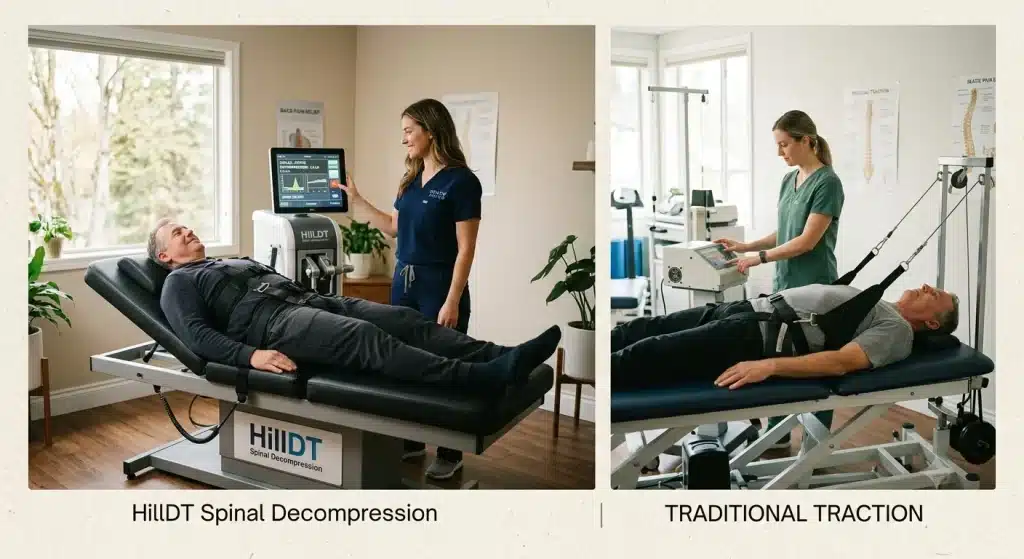
Traditional spinal traction and HillDT spinal decompression both work by gently stretching the spine. The difference is how that stretch is delivered.
Traditional spinal traction usually applies a steady, linear pulling force. For some patients, this can cause muscle guarding, where the body tightens against the pull.
HillDT spinal decompression uses advanced sensor-driven technology to monitor resistance and adjust the force during treatment. This creates a more precise decompression effect designed to reduce pressure on targeted spinal discs.
For advanced disc-related pain, non-surgical spinal decompression may offer a more targeted approach than basic mechanical traction.

Understanding the Mechanics: How They Work
What is Traditional Spinal Traction?
Traditional spinal traction is an older mechanical approach that uses pulling force to stretch the spine. This may be done manually by a provider or mechanically with a traction table, harness, or pulley-based system.
The goal is to create space between the vertebrae, reduce compression, and temporarily relieve pressure on joints, muscles, or irritated nerves. It may be used in physical therapy, chiropractic care, or rehabilitation settings.
However, traditional traction usually applies a more steady and linear pull. Because the body naturally protects itself from force, some patients may experience muscle guarding or spasms. When the surrounding muscles tighten, it can reduce the effectiveness of the stretch and make the session less comfortable.
Traction may still be useful for mild stiffness, general spinal tightness, or temporary relief, but it may not be targeted enough for more advanced disc-related problems.
What is HillDT Spinal Decompression?
HillDT spinal decompression is a more advanced form of non-surgical spinal decompression. It uses a computerized decompression table designed to apply controlled, gentle force to specific spinal regions.
Instead of using only a steady pull, the HillDT table monitors treatment force and patient resistance throughout the session. This allows the table to adjust the pull as the body responds.
The goal is to create negative intradiscal pressure inside the spinal disc. This pressure change may help reduce compression on affected discs and nerves while supporting the movement of fluid and nutrients back into the disc environment.
This makes HillDT spinal decompression especially relevant for patients with disc-related pain, such as a herniated disc, bulging disc, sciatica, or degenerative disc disease.
When Decompression Is Better
HillDT spinal decompression may be the better option when pain is related to disc compression or nerve irritation rather than simple muscle tightness.
It may be recommended for conditions such as:
- Herniated discs.
- Bulging discs.
- Sciatica caused by nerve compression.
- Degenerative disc disease.
- Chronic lower back pain related to disc pressure.
- Pain that radiates into the hips, legs, or feet.
- Disc-related symptoms that have not improved with basic stretching or rest.
The advantage of HillDT spinal decompression is precision. Its sensor-driven approach is designed to reduce the body’s tendency to resist the pulling force. This may allow for a more comfortable decompression experience compared with basic mechanical traction.
For patients trying to avoid surgery, HillDT decompression may be part of a conservative care plan. However, the right treatment depends on the diagnosis, severity of symptoms, and whether there are any red flags that require medical evaluation.

When Traction Is Better
Traditional spinal traction may still be helpful in simpler cases where the main issue is general stiffness, mild compression, or temporary discomfort.
It may be appropriate for:
- Mild spinal stiffness.
- General muscle tightness.
- Non-disc-related back discomfort.
- Simple spinal alignment issues.
- Temporary mobility restrictions.
- Patients looking for a budget-friendly stretching option.
- Situations where advanced disc rehabilitation is not necessary.
Traction may also be used as an add-on in physical therapy or chiropractic care. For some patients, it can provide short-term relief and improve comfort during movement.
However, if the pain is severe, radiating, recurring, or connected to a herniated disc, sciatica, or degenerative disc disease, a more targeted decompression approach may be worth considering.
Cost Comparison
| Feature | Traditional Spinal Traction | HillDT Spinal Decompression |
| Technology | Standard mechanical pull or linear traction | Sensor-driven computerized feedback system |
| Cost per Session | Generally lower; may be included in physical therapy or basic care | Usually higher because of specialized equipment and protocol-based care |
| Total Sessions Needed | Varies; often used as a temporary add-on | Often structured as a multi-session care plan, commonly around 15–24 sessions |
| Long-Term Value | May provide temporary relief for mild stiffness or simple compression | May offer more targeted support for disc-related pain and long-term rehabilitation goals |
| Best Fit | General stiffness or mild mechanical discomfort | Herniated disc, bulging disc, sciatica, or degenerative disc disease |
Cost depends on the clinic, diagnosis, treatment plan, and insurance coverage. Traditional traction may be less expensive per session, while HillDT spinal decompression often requires a higher investment because it uses specialized technology and a structured protocol.
Recovery Timeline: What to Expect
During the first 1–5 sessions, patients may experience gentle stretching, mild soreness, or immediate pressure relief. Some people feel more mobile early in care, while others need several sessions before noticing major changes.
During sessions 6–12, patients may begin to notice a clearer reduction in localized back pain, leg pain, or sciatica symptoms. This is also when the body may start adapting to improved spinal mobility.
After session 15 and beyond, the goal is often improved movement, better stability, and longer-lasting back pain relief. For disc-related conditions, the full timeline depends on the severity of the herniated disc, degenerative disc disease, nerve involvement, and overall health.
Which Should You Choose?
Choose HillDT spinal decompression if:
- You have a herniated disc or bulging disc.
- You have sciatica or radiating leg pain.
- You have degenerative disc disease.
- Your pain is recurring or chronic.
- You want a non-surgical spinal decompression option.
- You are trying to avoid more invasive treatment when appropriate.
- You need a targeted approach for disc-related back pain relief.
Choose traditional spinal traction if:
- Your discomfort is mild.
- Your pain feels more like general stiffness.
- You do not have severe nerve symptoms.
- You want a temporary stretch or short-term relief.
- Your provider recommends traction as part of basic rehabilitation.
If you are dealing with structural disc damage, nerve compression, or chronic back pain that has not improved with basic care, HillDT spinal decompression may be the stronger option. If your symptoms are mild and mostly muscular, traditional traction or standard chiropractic care may be enough.
The best next step is to consult a specialist who can evaluate your spine, symptoms, and imaging history before recommending a personalized treatment plan.
Frequently Asked Questions
Is HillDT spinal decompression painful?
HillDT spinal decompression is designed to be gentle and comfortable. Because the table monitors patient resistance and adjusts the treatment force, many patients find the session relaxing. Some people may feel mild soreness afterward as the body adapts, but the treatment itself should not feel aggressively painful.
How many sessions of HillDT decompression will I need?
A common protocol may range from 15 to 24 sessions over several weeks. However, the exact number of sessions depends on your condition, symptom severity, spinal alignment, disc involvement, and response to care. A provider can give a more accurate timeline after an evaluation.
Does health insurance cover non-surgical spinal decompression?
Coverage varies widely. Traditional traction may be covered under physical therapy or standard rehabilitation benefits. Advanced non-surgical spinal decompression may require out-of-pocket payment or specialized chiropractic coverage. Always check with your insurance provider and the clinic before starting treatment.
Final Thoughts
When comparing HillDT spinal decompression vs traditional spinal traction, the main difference is precision.
Traditional traction uses a simpler pulling force that may help with mild stiffness or temporary relief. HillDT spinal decompression uses sensor-driven technology designed to provide more controlled decompression for disc-related conditions.
For herniated discs, bulging discs, sciatica, and degenerative disc disease, HillDT spinal decompression may offer a more advanced, targeted conservative option. For mild tightness or general stiffness, traditional traction may be enough.
If your back pain is persistent, radiating, or interfering with daily life, schedule an evaluation to find out which treatment is right for your spine.